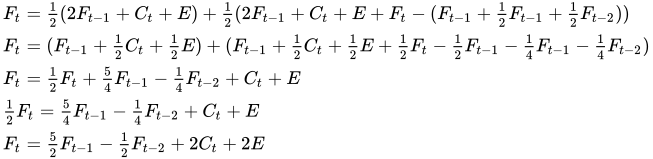
There are many different formulae and calculations and interesting data in Tibia. For example how much experience you need for a level, how much mana you need for a magic level, how long time it takes to advance in different skills, how long time a day in Tibia is counted in real life time, etc etc.
Character Statistics
Experience
For the amount of experience needed to reach a certain level:


For the amount of experience needed to reach the next level:

- For details about the Level Formula, visit this page.
Skills
All the skills advance using the same base formula with different parameters. Skill advance is based on skill points, which are mana points used for Magic Level, hits for Melee, Distance Fighting and Shielding and attempts for Fishing. The general formulae are:
Points required to advance to next skill level:

Total points at a certain skill level:
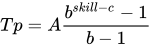
Skill level given a certain amount of skill points:

where,
- A = skill constant,
- b = vocation constant,
- c = skill offset;
- Tp = total skill points;
- Skill = skill level;
The skill offset (c) is the starting skill. It's 0 for Magic Level and 10 for all other skills.
The skill constants are the same for all vocations. They are as follows:
| Skill | Constant |
|---|---|
| Magic Level | 1600 |
| Melee skills | 50 |
| Distance Fighting | 30 |
| Shielding | 100 |
| Fishing | 20 |
Since a character can block up to two creatures using a Shield at a time, in ideal training scenarios the Shielding constant is the same as the Melee constants. For Offline Training, however, it does make Shielding training half the rate of Melee training.
The vocation constants change for each vocation and each skill. The higher the constant, the higher the amount of points needed to advance to the next skill level. They are as follows:
| Vocation | Magic | Axe/Club/Sword | Fist | Distance | Shielding | Fishing |
|---|---|---|---|---|---|---|
| None | 3.0 | 2.0 | 1.5 | 2.0 | 1.5 | 1.1 |
| Knight | 3.0 | 1.1 | 1.1 | 1.4 | 1.1 | 1.1 |
| Paladin | 1.4 | 1.2 | 1.2 | 1.1 | 1.1 | 1.1 |
| Sorcerer | 1.1 | 2.0 | 1.5 | 2.0 | 1.5 | 1.1 |
| Druid | 1.1 | 1.8 | 1.5 | 1.8 | 1.5 | 1.1 |
| Monk | 1.25 | 1.4 | 1.1 | 1.5 | 1.15 | 1.1 |
For example, this is the mana spent required for a Druid or Sorcerer to advance to the next Magic Level:

And the total mana used at a certain Magic Level:
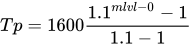
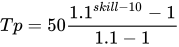
Similarly, for a Knight training a Melee skill, we have:

Base Damage and Healing
Prior to October 18 2022 (patch 13.05.12657), damage and healing increased at a rate of 1 per 5 levels, with the first increase happening at level 5. After this patch the scaling was reduced, and now is determined like so:
- Until level 500: no change, damage and healing +1 every 5 levels
- As of level 501-1100: damage and healing +1 every 6 levels
- As of level 1101-1800: damage and healing +1 every 7 levels
- As of level 1801-2600: damage and healing +1 every 8 levels
- As of level 2601-3500: damage and healing +1 every 9 levels
- Above level 3500 it continues with the same logic (steps of 500, 600, 700, etc.)
The step size S, or how many levels it takes to gain 1 base damage and healing, is calculated as follows, based on your level L:
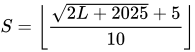
The total base damage and healing B as a function of your level L is calculated as follows, using S from above:

Mana Training Time
This formula enables you to calculate how much time is needed to increase a Magic Level.

is the time needed to increase a Magic Level, in hours;
is the current Magic Level;
is the percent you have left to go to the next Magic Level in decimal form (i.e. 47% = 0.47).
is the Vocation factor, depending on Mana regeneration:





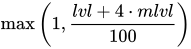
Magic Power
Usually displayed as percent.
Hitpoints, Mana, and Capacity
| Vocation | Hitpoints | Mana | Capacity | |||
|---|---|---|---|---|---|---|
| Per Level | Total | Per level | Total | Per level | Total | |
| Knights | ||||||
| Monks | ||||||
| Paladins | ||||||
| Sorcerers and Druids | ||||||
| Rookies | ||||||


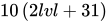


What is worth noting, Rookies gain the lowest possible values per level among all vocations.

The sum of HP, MP and Cap does not depend on vocation, providing balance between them (assuming, of course, they are each desired equally, which is often not the case).
Speed
- For details about the equipment increasing speed, visit this page.
Note that spells like Haste and Strong Haste increase your base speed without items and mount, you have to add the speed of the extra items and mount only after calculate your base speed with the spells.
Your speed helps determine how fast you walk in the game. The base speed for a level 1 player is 110.
The type of surface you walk on reduces your speed (i.e. you walk faster on pavement than you do on grass or mud). Below are the formulae for determining your speed in different states.
Base Speed
A character's base speed is determined by
The modifiable speed value, however, is equal to
This is important when dealing with multiplicative buffs and debuffs such as speed spells.


Speed breakpoints
This formula tells you the required speed to reach a particular speed breakpoint. Note that the result, S, refers to the speed as displayed in your skills window, which takes into account your level, equipment and buffs.
For example, if you want to know what speed you need in order to reach the "GM speed" in depots, you would plug in the values F=100, B=50, and the result would be 2382. And if you want to know what speed you need in order to reach the second from last breakpoint in the secret library, you would plug in the values F=150, B=100, and the result would be 1258.
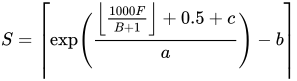
Where:
- F = tile friction. See Speed Breakpoints for examples.
- B = desired tile movement speed in milliseconds. This must be a multiple of 50, because all movement speeds in Tibia are multiples of 50 ms. Again, see Speed Breakpoints for examples.
- S = speed required for the breakpoint.
- a = 857.36
- b = 261.29
- c = 4795.009
 Haste
Haste

This determines someone's speed after casting Haste. It replaces any other haste buff.
 Strong Haste

This determines someone's speed after casting Strong Haste. It replaces any other haste buff.
 Swift Foot

This determines a paladin's speed after casting Swift Foot. It replaces any other haste buff.
 Charge

This determines a knight's speed after casting Charge. It replaces any other haste buff.
 Adrenaline Burst

This determines someone's speed after the Adrenaline Burst charm is triggered. It replaces any other haste buff.
Prey System
Timer Deductions
All bonuses have specific triggers upon which time is deducted from the remaining time of a prey bonus. Much like stamina, time is deducted based on the recent activity of the player. The amount of time deducted is equal to:


Where:
currentTimeis the current system time. This is used to compute time relative to the last trigger time.lastTriggerTimeis the system time of the last relevant trigger event. The lists of relevant trigger events for each bonus type are listed below.
The triggers that are used to deduct time depend on the specific bonus. For example, when the user takes damage, the timer for damage reduction will be affected, but not the timer for experience gain. These triggers act on any event of the specified type, not just ones that would be affected. If an increased loot bonus is active for killing Rats, killing a Spider will affect the timer even though Spiders do not provide bonus loot. The triggers for each type of bonus are as follows:
Damage Reduction - time is deducted when:
- the user takes damage, whether PvP or PvE.
- the user gains experience from a slain creature.
- [NOT TESTED]: gaining experience from a quest or other non-combat event.
Damage Increase - time is deducted when:
- the user gains experience from a slain creature.
Loot Increase - time is deducted when:
- the user gains experience from a slain creature, irrespective of whether or not that creature has a corpse.
- [NOT TESTED]: gaining experience from a quest or other non-combat event.
Bonus Experience - time is deducted when:
- the user gains experience from a slain creature.
- [NOT TESTED]: gaining experience from a quest or other non-combat event.
Value and Effect
When bonuses are determined, two values are generated: the bonus type (damage increase, damage reduction, etc.) and bonus value. The effect of a bonus is a function of its value according to the following functions.
Damage Increase:

Damage Reduction:

Bonus Experience:

Improved Loot:
| Bonus | Minimum | Step |
|---|---|---|
| Damage Increase (%) | 5 | 2 |
| Damage Reduction (%) | 10 | 2 |
| Bonus Experience (%) | 10 | 3 |
| Improved Loot (%) | 10 | 3 |
Combining these formulas provides a generalized formula:

Where:
minimumis the theoretical effect at value = 0 (equal to E(1) - step).stepis the effect's step. For each value, the effect increasessteppercent.
Imbuing
Mana Leech
When one of the Void imbuements is triggered by area attacks, the mana leeched is not the same as it would be for one creature multiplied by the number of creatures, otherwise this imbuement would be too powerful. There are a few ways to calculate the actual mana gained. One way of looking at it is to consider that 100% of the leech is applied to one creature, and 10% of it to the other creatures, though this does not allow for an accurate calculation when different resistances are involved.
In reality, for each creature the mana leeched is the following:
,

where N is the number of creatures attacked and Leech is the Leech % depending on the level of the imbuement (Basic, Intricate or Powerful). Furthermore, the result is always rounded up. For N = 1, this simplifies to:
,

as one would expect.
Notes:
- Since the value is always calculated independently for each creature and rounded up, simply multiplying the first formula by N and consider the total damage dealt does not result in the total mana leeched and will underestimate the real value.
- Damage preys do not influence the mana/health leech amount, but Critical Hits do increase the leech.
- "Overkill" damage dealt above maximum health/current health of a monster still counts for leech.
Magic Shield
The Magic Shield caused by the Magic Shield Spell or the Magic Shield Potion only absorbs a limited amount of damage before breaking. When this mana is depleted the spell effect disappears. The amount of mana it absorbs depends on the character's Level and Magic Level, including equipment and skill boosts active at the moment the spell is cast, according to this formula (rounded up to the next whole number), where L is your level and M is your magic level:

If you have unlocked the Enhanced Magic Shield Conviction Perk on the Sorcerers' Wheel of Destiny, then the formula is:

Bosstiary
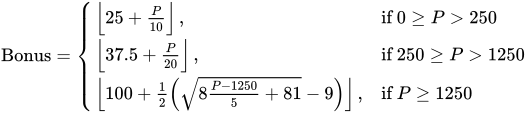
Equipment Loot Bonus as a function of boss points P is calculated according to this formula:
Combat
Spell/Rune Damage/Healing
NOTE: These formulae are based upon observed values. Since the latest Vocation Adjustments Update in 2020, they are no longer correct.
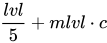
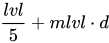
All the spells have the same basic formula: , where is a decimal number and is an integer.
For PvP damage, just divide the final result by .
Healing spells:
Light Healing
Max healing:
Min healing:
Intense Healing
Max healing:
Min healing:
Wound Cleansing
Max healing:
Min healing:
Fair Wound Cleansing
Max healing:
Min healing:
Mass Healing
Max healing:
Min healing:
Ultimate Healing
Max healing:
Min healing:
Instant attack spells
Strike spells
Max damage:
Min damage:
Divine Missile
Max damage:
Min damage:
Ice Wave
Max damage:
Min damage:
Fire Wave
Max damage:
Min damage:
Rune attack spells
Light Magic Missile
Max damage:
Min damage:
Heavy Magic Missile/Stalagmite
Max damage:
Min damage:
Icicle/Fireball
Max damage:
Min damage:
Holy Missile
Max damage:
Min damage:
Sudden Death
Max damage:
Min damage:
Thunderstorm/Stone Shower
Max damage:
Min damage:
Avalanche/Great Fireball
Max damage:
Min damage:































These spells have not been tested by me (yet) so I'll leave the old formulae here.
NOTICE: These formulae are based upon observed values with c calculated to one tenth with fair certainty
min:
max:
avg:
* c = Multiplier for min of the desired attack spell/rune
* d = Multiplier for max of the desired attack spell/rune
The c values are roughly:

| c value | spell |
|---|---|
| 0 | Explosion [adevo mas hur] (note: the min damage of this spell is 0). |
| 2.5 | Energy Beam [exevo vis lux] |
| 4 | Great Energy Beam [exevo gran vis lux] |
| 4 | Divine Caldera [exevo mas san] |
| 3.5 | Terra Wave [exevo tera hur] |
| 4.5 | Energy Wave [exevo vis hur] |
| 10 | Heal Friend [exura sio] |
| 5 | Rage of the Skies [exevo gran mas vis] |
| 7 | Hell's Core [exevo gran mas flam] |
| 5 | Wrath of Nature [exevo gran mas tera] |
| 6 | Eternal Winter [exevo gran mas frigo] |
| 18.5 | Divine Healing [exura san] |
The d values are roughly:
| d value | spell |
|---|---|
| 4.8 | Explosion [adevo mas hur] |
| 4 | Energy Beam [exevo vis lux] |
| 7 | Great Energy Beam [exevo gran vis lux] |
| 6 | Divine Caldera [exevo mas san] |
| 7 | Terra Wave [exevo tera hur] |
| 9 | Energy Wave [exevo vis hur] |
| 14 | Heal Friend [exura sio] |
| 12 | Rage of the Skies [exevo gran mas vis] |
| 14 | Hell's Core [exevo gran mas flam] |
| 10 | Wrath of Nature [exevo gran mas tera] |
| 12 | Eternal Winter [exevo gran mas frigo] |
| 25 | Divine Healing [exura san] |
Melee
Attack Value
Attack value can be found in the Combat Stats section of the Cyclopedia and is described as follows:
This is your character's basic attack power whenever you enter a fight with a weapon or your fists. It does not apply to any spells you cast. The attack value is calculated from the weapon's attack value, the corresponding weapon skill, combat tactics and the player's level. The value represents the average damage you would inflict on a creature which had no kind of defense or protection.
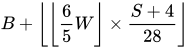
The formula for attack value is as follows:
B = base attack damage, W = weapon attack, S = skill.
Offensive Mode:
Balanced Mode:
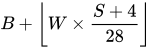
Defensive Mode:
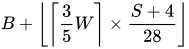
Note that the defensive mode formula has a ceiling function rather than a floor function for the weapon damage part. The formula for minimum and maximum damage is not currently known.
Defense Value
Defense value can be found in the Combat Stats section of the Cyclopedia and is described as follows:
This is your protection against all physical attacks in close combat as well as all distance physical attacks. The higher the defense value, the less damage you will take from melee physical hits. The defense value is calculated from your shield and/or weapon defense and the corresponding skill. Careful! Your defense value protects you only from hits of two creatures in a single round.
The formula for defense value is as follows:
D = shield or weapon defense, S = skill.
If you are wearing a shield, the value of D is the Def value of your shield plus any defense modifier on your weapon. The value of S is your shielding skill.
If you are not wearing a shield, the value of D is the Def value of your weapon (ignoring the defense modifier on it). The value of S is the melee skill that corresponds to your weapon.
Offensive Mode:
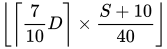
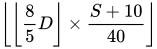
Balanced Mode:
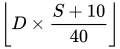
Defensive Mode:
Melee-Based Spells
NOTE: These formulae are based upon observed values. Since the latest Vocation Adjustments Update in 2020, they are no longer correct.
- atk = Weapon's attack
min:
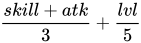
max:
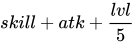
avg:

min:
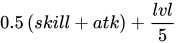
max:
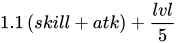
avg:

min:
max:
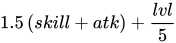
avg:

min:
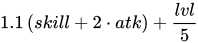
max:

avg:

Note: As usual, damage is reduced by armor but none of these abilities can be blocked by shielding. Also note, this doesn't take into account monsters weakness or strength to physical damage and if you use blood rage, you'll have to use the appropriate skills in place of your normal skills.
Distance
NOTE: These formulae are based upon observed values. Since the latest Vocation Adjustments Update in 2020, they are no longer correct.
- Minimum Damage:
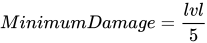
- Maximum Damage:

- = Weapon's attack
- = Damage Factor:
- Full Attack:
- Balanced:
- Full Defence:


To calculate your damage in PvP, divide the result by .
Note that armor of the target will reduce your damage.
- Chance to hit (without weapon hit chance modifier)
| Distance | 1H weapon (throwing) | 2H weapon (any bow or crossbow) | Any bow + Sniper Arrows |
|---|---|---|---|
| 1 | |||
| 2 | |||
| 3 | |||
| 4 | |||
| 5 | |||
| 6 | |||
| 7 |
















Distance-Based Spells
NOTICE: This formula is based upon observed values.
min:
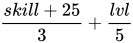
max:
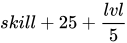
avg:

Armor
Note that:
- Armor reduction will only apply when damage crosses the shield.
- The damage armor needs to reduce may be lower than original damage because of the shield reduction.
- If you get a negative number as armor reduction, it means 0.
- Floor function is used here, basically it means that we remove decimals.
- Ceil function is used here, basically it means that we round up numbers with decimals to next integer.
Variables:
- r = minimum armor reduction
- R = maximum armor reduction
- t = total armor
- d = damage (after the shield)
- p = percentage reduction of item
Armor Reduction

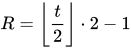
- where denotes floor function (rounding down).

Percentage Reduction
This formula have to be applied for every single item that has percentage reduction.
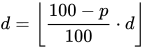
Example
You get a hit with original value of 200 wearing only Zaoan Helmet and Protection Amulet
- t = total armor = 9
- r = 4

-
- R = 7

Now we calculate the % reduction that Zaoan Helmet has
- p = 5
- d = 190
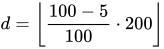
Now we calculate the % reduction that Protection Amulet has
- p = 6
- d = 178
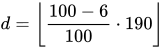
For this example, damage becomes 178, minimum armor reduction will be 4 and maximum armor reduction will be 7, so the hit will hit you from 171 to 174.
Armor and Defense
- Damage reduction
Min:

Max:

- Attack of Creature = a
(Let's supose that a creature has a max damage of 500. The attack of creature will be a random number from 1 to 500)
- Defense = b (Defense value of your shield plus your weapon modifier or defense value of your two handed weapon)
- Total Armor = c (Make a sum of all your set arm value)
- Shielding = d
- Defense factor = e
Full Attack: 5
Balanced: 7
Defensive: 10
Now use the following equations:


NOTICE: The max damage of a creature could be higher than the max damage in creatures page.
Equipment Upgrade
Fusion
The general formula for average fusion cost that does not include Exalted Core cost is:

Where:
- is success rage (50% or 65%).
- is tier loss (100% or 50%).
- is cost of forging to tier in gp.
- is value of an item at tier in gp.
- is base item value without tiers.
- is always 0.


When taking into account bonuses from Exalted Cores, we can derive following formulas:
- Average fusion cost without using any Cores (50% success, 100% tier loss):

- Average fusion cost using one Cores to increase success rate (65% success, 100% tier loss):

- Average fusion cost using one Cores to decrease tier loss (50% success, 50% tier loss):

- Average fusion cost using two Cores (65% success, 50% tier loss):

- Where:
is cost of one Exalted Core in gp.

Example 1: Upgrading a Class 1 item to Tier 1 without any Soul Cores:
- gp
- gp
- gp



Example 2: Upgrading a Class 4 item to Tier 1 with two Soul Cores:
- gp
- gp
- gp
- gp




Example 3: Upgrading a Class 4 item to Tier 2 with two Soul Cores:
- gp
- gp
- gp
- gp
- gp



Deeper dive, explanation of the derivation of the fusion formula:
Lets derive the formula for success rate and tier loss . This will use one Exalted Core.


There are two outcomes:
- Fusion succeeds:
- consumes: 2 items of value , gold of value , one exalted core of value
- total cost being:
- Fusion fails:
- consumes: 2 items of value , gold of value , one exalted core of value
- total cost being also:
- but we are left with:
- first item
- 50% chance that second item keeps its tier:
- 50% chance that second item loses tier:
- and we have to perform the fusion for again thus total cost minus cost of what we are left with is:


Combining both outcomes, each having 50% chance we get: